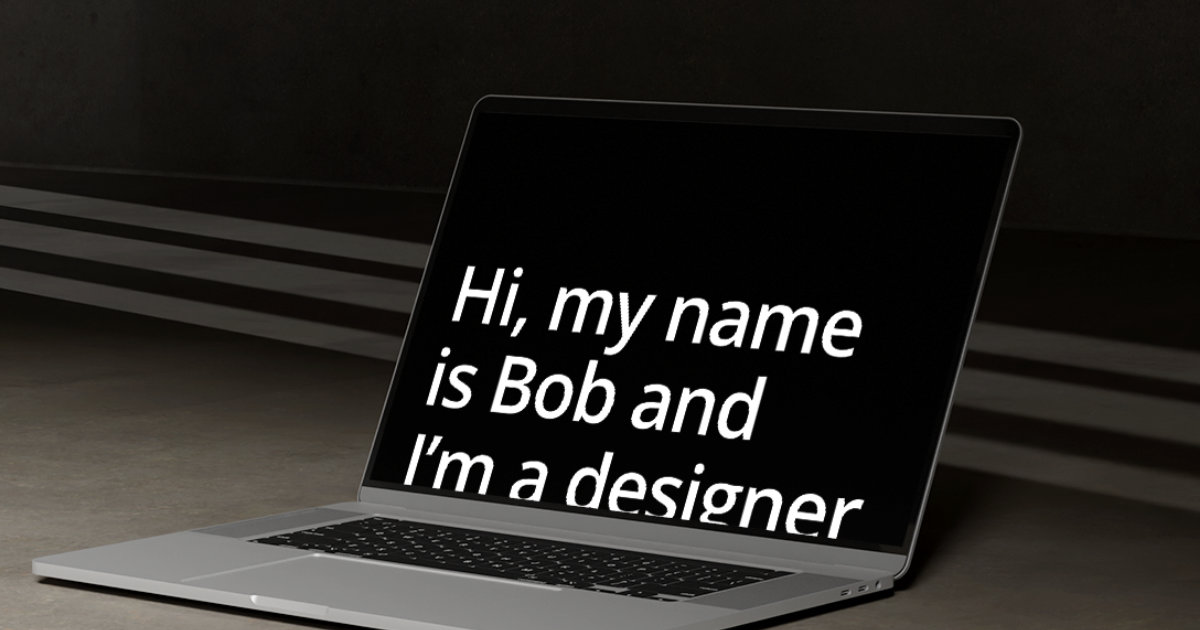
The Boring Intro Epidemic
I’ve reviewed thousands of portfolios over the years, and there’s a pattern that keeps showing up. They almost all start the same way: “Hi, I’m [Name], a Creative Director with 15 years of experience in brand strategy and digital storytelling.” It’s clinical, it’s accurate, and it puts people to sleep.
I used to do the exact same thing because that’s what we’re taught to do — lead with your credentials, list your experience, hope the right person reads it. But here’s the truth I’ve learned recently: nobody gives a shit about your title. They care about their own problems. If your website is a monument to your resume, you’re missing the point of having a site in the first place.
And it’s not just websites. It’s the first thing you say in a Zoom intro. It’s your LinkedIn headline. It’s the opening line when someone at a conference asks “so what do you do?” Every single one of those moments is either making someone lean in or making their eyes glaze over. And most of us are choosing the glaze-over option because we think professionalism means being boring.
The Hero Trap
Most creative leaders fall into what I call the “Hero Trap.” We want to be the star of the show, the visionary with the big ideas. But in the story of your client’s business, they are the hero, not you. You’re Yoda, not Luke. You’re Alfred, not Batman. The moment you make your intro about your credentials, your years, your awards — you’ve cast yourself as the main character in someone else’s story. And nobody hired you to be the main character. They hired you to help them win.
I was watching this masterclass by Clay Hebert, and he said something that completely reframed how I think about this: your intro isn’t about you, it’s about who you help.
Think about it like this. If you meet someone on a plane and they ask what you do, and you say “I’m in marketing,” the conversation dies. It’s too complete and too boring. There’s nothing for the other person to grab onto. But if you use Hebert’s “verb their noun” formula, everything changes.
Instead of “I’m a designer,” try “I help founders fund their dreams.”
Now you’ve opened a loop. Now they’re asking, “How do you do that?” That’s where the magic happens. You’ve gone from being a commodity to being a guide. You’re no longer just a person with a laptop; you’re the person who unlocks the result they’ve been losing sleep over.
The Formula: Verb Their Noun
Let’s break this down because it’s deceptively simple. The structure is:
“I help [audience] [verb] their [noun].”
That’s it. Three variables. But the power is in what it forces you to do: define who you actually serve, name the action you enable, and point to the outcome they care about. Not the deliverable. Not the medium. The outcome.
Here’s what most creatives say vs. what they could say:
| What You Say | What You Could Say |
|---|---|
| “I’m a brand designer” | “I help startups own their category” |
| “I’m a Creative Director” | “I help teams ship work that doesn’t get ignored” |
| “I do UX/UI” | “I help products stop losing users at the door” |
| “I’m a freelance illustrator” | “I help authors sell books before anyone reads a word” |
| “I run a design studio” | “I help founders launch brands people actually remember” |
See the difference? The left column describes what you are. The right column describes what happens when someone works with you. One is a label. The other is a promise. People don’t buy labels. They buy promises.
And here’s the other thing — the “verb their noun” format creates curiosity. It’s intentionally incomplete. When you say “I help startups own their category,” the natural response is “wait, how?” That’s an invitation to a conversation. “I’m a brand designer” is a conversation ender.
Why This Matters More Than You Think
Here’s where this gets real. Your introduction isn’t just small talk at a networking event. It’s the first line on your website. It’s the headline of your LinkedIn. It’s the opening slide of your portfolio presentation. It’s the first 10 seconds of every new client call.
Every time you default to “I’m a Creative Director,” you’re burning an opportunity to make someone lean in.
I’ve been in hiring reviews where two candidates had nearly identical portfolios — similar quality, similar experience level. But one of them opened their site with something like “I help brands stop blending in,” and the other opened with “Senior Art Director, 12 years experience, specializing in brand identity and campaign development.” The first one made me want to keep reading. The second one felt like every other portfolio I’d seen that week. The work was comparable, but the framing changed how I experienced everything that came after it.
And this extends beyond just landing clients or jobs. When you frame yourself as the guide instead of the hero, you change the entire dynamic of how people relate to you. Stakeholders listen differently, clients trust more quickly, and collaborators see you as someone who’s there to elevate the work rather than claim credit for it. Your intro sets the frame for every relationship that follows.
Your intro is doing more heavy lifting than you realize. It’s either opening doors or quietly closing them before you even get to show your work.
The Slot Machine Exercise
Alright, enough theory. As the creative leader, you need to audit your messaging right now. Stop trying to find the one “perfect” line — that’s just perfectionism disguised as strategy, and it’ll keep you stuck forever. Instead, create a spreadsheet with three columns: Verb, Audience, and Noun. Mix and match them like a slot machine until you find a combo that clicks.
Here’s a starter set:
Verbs: help, launch, grow, unlock, build, scale, transform, fix, protect, accelerate
Audiences: founders, startups, teams, brands, creators, agencies, executives, small businesses
Nouns: revenue, attention, credibility, category, audience, story, culture, identity, momentum, trust
Now pull: “I help founders unlock their credibility.” “I help brands scale their story.” “I help teams build their culture.” Some of these will be garbage. That’s the point. You need volume before you get quality. Aim for 20-30 pulls, then circle the 3 that hit the hardest. Sleep on it. Come back tomorrow. Pick one.
Instead of “I design logos,” you now have “I help startups own their category.” One describes what you do all day. The other tells someone why they should care.
I recently went through this exercise myself. After years of introducing myself as a Creative Director, I landed on: “I help founders turn their brand into customer demand.” That’s what’s on my site right now. It took me a bunch of bad pulls to get there, but once I found it, everything about my positioning clicked. The way people responded to my work changed because the frame changed before they ever saw a single project.
The Real Test
Here’s how you know if your intro is working: show it to someone who has no idea what you do and see if they ask a follow-up question. If they say “oh, cool” and change the subject, your intro is dead. If they say “wait, how do you do that?” — you’ve got it.
Your intro should create a gap between what you said and what they want to know. That gap is curiosity. And curiosity is what gets you the meeting, the callback, the project.
Your Move This Week
Stop being a “Creative Director” and start being the person who verbs the noun your clients care about. IDK about you, but I’d rather be the guide who helps someone win than the hero who stands alone.
Try the slot machine exercise on your own site. Open your portfolio, read the first two sentences, and ask yourself — does this make someone curious, or does it make them scroll past? If it’s the latter, three columns, ten pulls, and pick the one that feels right. I go deeper on this in the video: Fix Your Introduction on YouTube
What’s the one result your clients are actually desperate for? That’s your noun. Now find the verb. If you want help, reply to the newsletter or drop a comment — let’s workshop your “verb their noun” line together.
And if you’re tired of seeing boring portfolios, send this to a creative who needs a wake-up call.
-K